



The zirconia used in dental laboratories starts as an extremely fine zirconium oxide technical powder, stabilised with yttria (Y-TZP). Many of the final properties of the disc depend on this starting material.
For this reason, raw material quality is far from a secondary consideration: it is one of the foundations on which the material is technically developed. A high-quality powder is defined by its chemical purity, particle size, uniformity and production method — characteristics that may be invisible to the eye, but play a decisive role in determining the behaviour of the finished material.
Chemical purity
In a brittle material such as zirconia, fractures almost always originate from a defect. Even small impurities can become weak points, creating areas of internal stress or potential fracture initiation sites. This is why it is so important to select a chemically pure powder, free from metallic contaminants or processing residues.
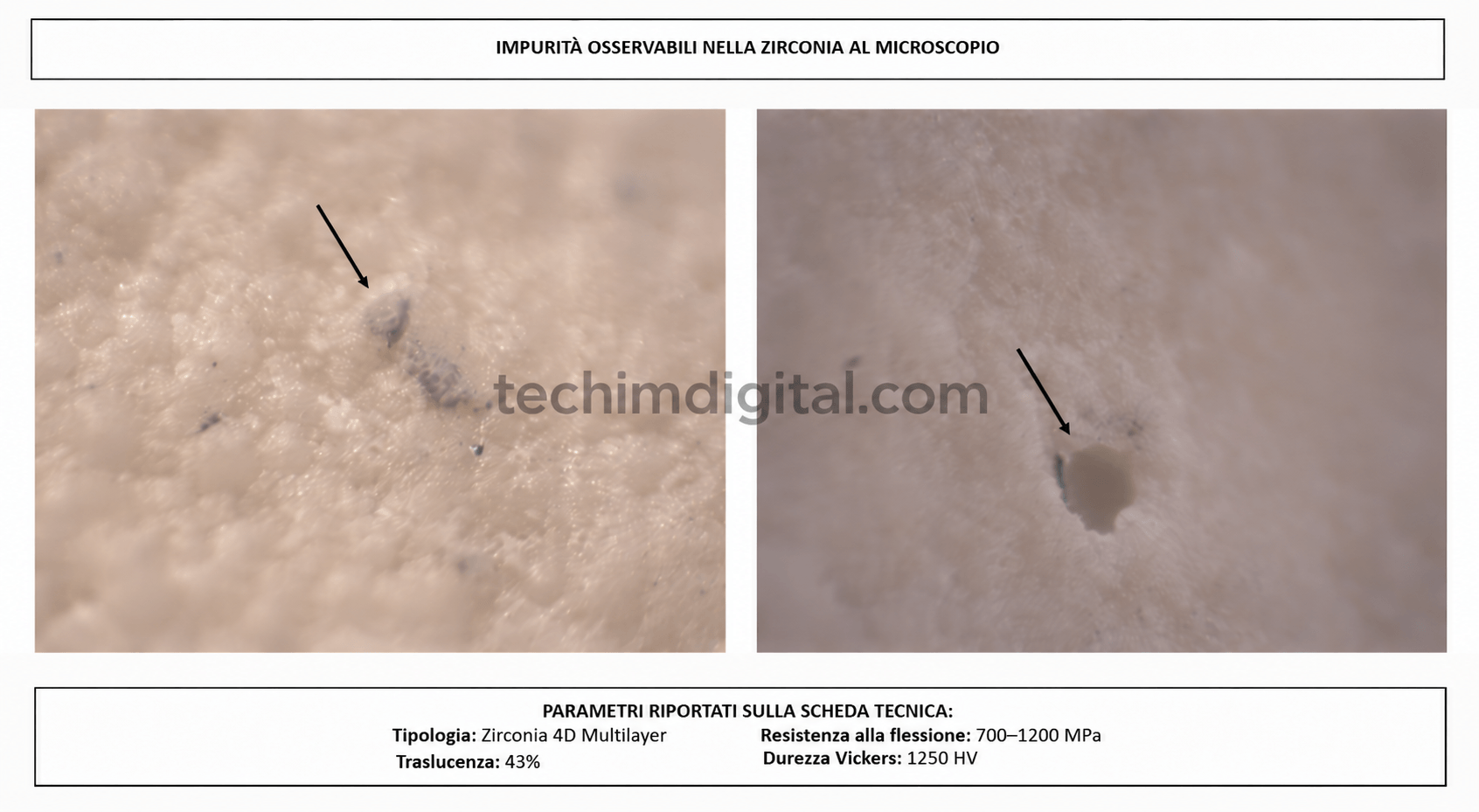
IMAGE: A technical data sheet doesn’t always tell the whole story.
Particele size and uniformity
Irregular particles can compromise the strength of the material and make its behaviour less predictable during processing and, above all, during sintering. Another critical factor is the presence of agglomerates, which can create invisible internal defects and potentially lead to sudden material failure.
A high-quality powder, on the other hand, consists of particles with a consistent size distribution. These particles are distributed more evenly, helping to create a denser material and reducing the formation of internal voids.
Powder production methods
Two of the most common methods are co-precipitation and hydrothermal synthesis.
In co-precipitation, liquid zirconium and yttrium compounds are precipitated together through the addition of a reagent, producing a solid powder. This method makes it possible to manufacture large quantities of material while maintaining good control over its chemical composition.
From a structural perspective, however, the resulting powder may exhibit a degree of irregularity, as particles tend to form small agglomerates and their size is not always perfectly uniform. This introduces variability that needs to be properly managed during the subsequent stages of production.
A different approach, both in terms of cost and complexity, is hydrothermal synthesis, which takes place under high temperature and pressure inside a sealed reactor. In this controlled environment, particles form in a more orderly and uniform way, producing a powder with more consistent characteristics and more predictable behaviour during the subsequent stages of the manufacturing process.
Conclusion
Purity, uniformity and control of the powder determine the potential of zirconia, but that potential can only be fully realised through the careful selection of these parameters. NatZir is the result of a technical development process that goes beyond the finished product, beginning with the definition of standards upstream, including the selection and evaluation of the raw material.